

RAF Families Survey March 2001
Housing
The majority of families who replied were living in quarters or substitute families accommodation (62.6%).Over half of respondents owned a house. Out of those who owned their own homes, 27.6% were currently living in quarters.
Spouses should be allowed to co move in/move out?
There is no difficulty with spouses attending move in/move out with their Service partner. As the following extract from housing regulations (JSP 464 Para 0512) shows, spouses may also conduct a move-in/move out on their own if necessary:
- There are 3 categories of individual who may take over the allocated and accepted SFA as follows:
- The Service person's spouse in circumstances where the Service person cannot attend Move In/Move Out for Service reasons. Written authority (Proxy Certificate) must be given by the Service person to the spouses to take over the property and to sign the inventory on the Service person's behalf.
Top
19.8% of those with children reported problems in finding schools. (This percentage has risen steadily since the survey started in Mar 95 when problems were reported by 13.9% of parents)
Admission to schools has become a bigger problem since the introduction of parental choice and the imposition of class size limits. In order to show the Department of Education and Skills how badly existing regulations affect children whose parents are in the military, the Service Families Task Force commissioned a special Moving Survey in Sep 01.
Results from the RAF segment of the moving survey showed that over a quarter of parents (26.7%) found problems in getting their children into the school they preferred. The parents tried a variety of solutions including writing to the Head Teacher or Local Education Authority and several successfully appealed through the existing appeals procedure.
Professional help is available through the Service Children's Education agency.
Tel: (Civil)
Tel: 94344 Ext. 8244 (Military)
Top
How well were you supported when your spouse was detached?
Following up on comments made in previous surveys, all units now use a checklist of 'best practice' measures to support families when the serving partner is deployed. We are keeping a close eye on the responses to this part of the survey to see how effective these measures really are. As well as monitoring responses to the Families Survey we are also asking about better ways of supporting families separated by deployment in our station Focus Groups.
| Mar 99 | Mar 00 | Mar 01 | Variation | |
| % who knew who their POC was | 40.3 | 46.5 | 49.0 | up |
| % contacted by their POC | 15.8 | 20.4 | 23.6 | up |
| % received information pack | 14.9 | 23.5 | 24.7 | up |
| % received RAF Form 1714 | 20.0 | 26.6 | 34.7 | up |
| % received PAM Air 410 | 23.1 | 31.3 | 28.2 | down |
72.6% of spouses said that information about RAF allowances was poor or very poor.
The only reason I know anything about these allowances is because of my job working for the Army. The RAF doesn't tell you what you are entitled to claim!
Although information about allowances and pay is 'in the public domain', it is not always easy for non-Service spouses to get hold of specific details.
There is a very easy-to-follow guide to RAF allowances called 'Check it Out'. Individual copies were sent out to everyone in the RAF in January 1998 detailing the major changes caused by the Review of Allowances. The RAF Allowances Ready Reference in January 2000 updated the rates for a variety of allowances. Again, copies were sent to all serving personnel. Both these booklets may also be found in Station Information Rooms and HIVEs.
However, there is now an easier way to find out what you need to know. The RAF Community website http://www.rafcom.co.uk lists all the current pay and allowances rates. It also has brief explanations of the various allowances to explain who qualifies for them and when. If you want to get into the detail of any allowances, the web site quotes the Queen's Regulation or Air Publication Leaflet that has the full story.
Additional Information: Allowances
Top
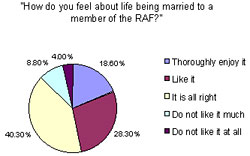
The largest proportion of the survey felt that their life, being married to a member of the RAF was 'all right".
In fact, despite the very real concerns about schools admission, dental care, quarters maintenance and deployments, under 13% of spouses dislike their present lifestyle. However, the points made in this survey will be of real practical help to the policy makers by identifying those areas where changes need to be made to produce real benefits for RAF families.
| Back | Top |